If the book’s title has a familiar ring, especially in December, it is because in some sense, it is an echo of the Christmas story of the Wise Men from 2000 years ago.
At that time, Persian wise men had unraveled a thousand-year-old prophecy from the religion of Zoroaster, in order to make a remarkable thousand-mile journey from the Persian East to the Roman/Jewish West. They discovered the infant Jesus at the time of His birth. And they worshipped Him, as the Promised One predicted by their own Zoroastrian religion.
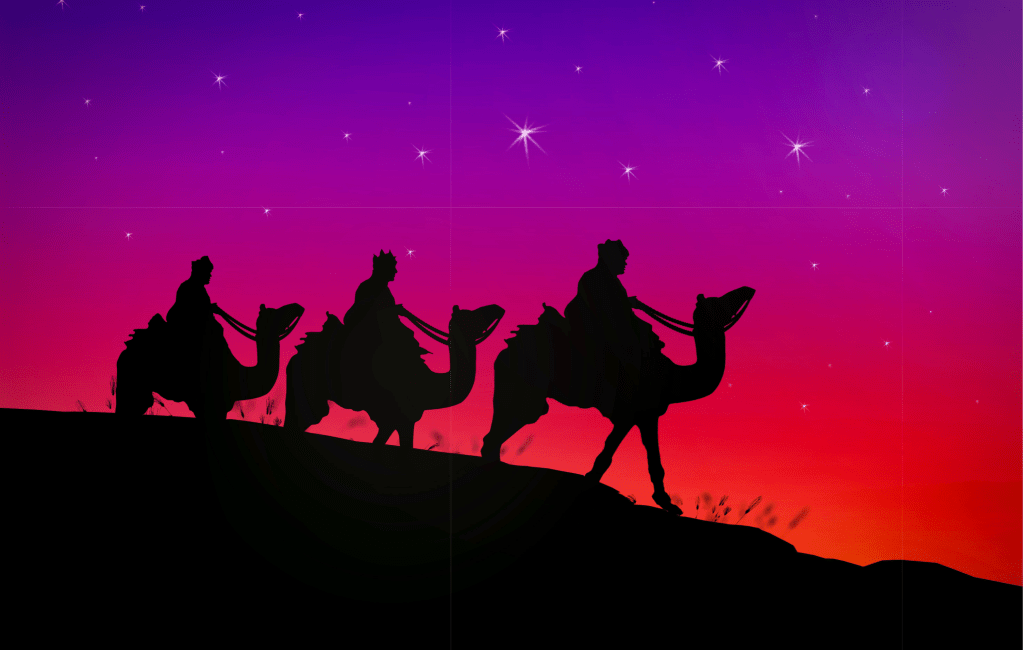
Later, after Jesus had grown, He gave us many wonderful lessons. And He also left us with some indications of the time of His return. Our lead characters, Zach and James, are following these indications eastward this time–to the Holy Land and beyond. In the process they are re-enacting the story in the more modern age, becoming the “Wise Men of the West”.
The Wise Men of the East were able to transcend the religious and cultural barriers that separated Zoroastrian Persia from the Jewish/Roman world. They came in search, without preconceived notions about what the “King of the Jews” must look like. They did not allow His birth in a manger, instead of a royal palace, to prevent them from seeing His spiritual reality.
Now, as Zach and James head eastward in the 1840s in their more modern search, will they be able to muster that same spirit of detachment and humility which guided the Wise Men of the East? And will it lead to a similar success?
 The Wise Men of the West
website looks good, Eileen
LikeLike
The story of Jesus Nativity is clearly made up of misinterpreted and misused OT Scriptures. Both stories contradict each other and both go against known laws and practises of the time. There was no requirement for Joseph to go to Bethleham Ephratah. His property, the reason for the tax, was in Nazareth. David had been dead nearly 1000 years – if he indeed lived as more than a tribal leader. The exagerrated story of his life is contradicted by the background on which it is written. Bethlehem – in that 1000 years had been through tribulations and then the Exile to Babylon and the chaos of the Maccabean Kngdom. It’s unbelievable than anyone of Davids family still lived there and more unbelievable he had property there. The writer of Matthews gospel some decades after the death of the Jewish preacher forgot that Pregnant women and weaning mothers were exempt from any form of travel – even to the Passover. See the story of Samuels birth. In any case, would a caring husband commit his heavily pregnant wife to a 3-4 day journey, with overnight stops in the open countryside with all the dangers, and food and hygiene problems – to put it simply. There were no inns to stay at. The rest of the story is simply made up using the OT scriptures to make the Jewish preacher divine. Hosea 11:1 talks of ‘my son Israel’ in Egypt. Nothing refers to Jesus. If Jesus is included by christianity he must have also completed the rest of the chapter. Did he? Luke puts Joseph in Nazareth 40 days after the birth. If herod’s soldiers had pursued him, just 20 miles north or east lay the safety of the Roman Province of Syria. To go the Egypt wopuld have meant a 300 mile trip south through the area the soldiers were searching. Roman province governers did not interfere in other Privinces affairs. If they did the Romans took swift action against the aggressors. As with Aretas, king od Damascus when he harrassed Antipas over a family matter. Astrologers certainly abounded in the East and were often invited to be at prominent events to give them significance. There is no case for their presence at the birth of a Jewish boy who would become a Jewish preacher.
LikeLike
Trevor—Some people believe that the Bible is a 100% accurate history of the times. I am not such a person. I understand the Bible to be a set of spiritual lessons, which can guide us all in our day-to-day decisions of living. Historical stories are sometimes used to illustrate a spiritual lesson. For instance, Jesus tells the story of the Good Samaritan. Did that man actually exist? Did he actually do the things that Jesus described? Maybe yes or no. But does it really matter? There is a spiritual lesson here about being a good neighbor. It transcends the confines of time and place. It would be applied at thousands and millions of times and places, as Christianity grew and spread. There are many such spiritual lessons in the scriptures of the world’s religions.
As to the question of the Magi (the actual term used in the earliest Biblical texts) or “astrologers” (a pejorative term), it is true that we don’t have much, in historical terms, on the details of their background and even less about their ultimate fate. But, as you will discover if you read my book, this is at least partly because the Roman-Christian world, which was assembling the Bible in the 4th century, did not want to give much credence to the Persian-Zoroastrian world, because it was Rome’s prime enemy. The fact that the Magi arrived because of “a prophecy of Zoroaster”, as was clearly stated in the Syriac Infancy Gospel, is a theological dilemma for a Christian world which wanted to confine all prior revelation to the Old Testament and ignore Zoroaster as a possible source of divine revelation.
It was also a theological dilemma for the Zoroastrian world because, if the prophecy of Zoroaster had been fulfilled by the coming of Jesus, it would have meant that the Zoroastrians should have become Christians. And the Zoroastrian leadership did not want to give up their positions of power (the typical reason that older religions resists the newer ones).
Thus, it remains as a delightful little story at the beginning of the New Testament, with few scholars interested in digging into the theological problems that are just below the surface, unless they are willing to acknowledge the possibility that spiritual lessons from Moses, Zoroaster and Jesus all came from a single Source. That’s where I come in.
LikeLike
I have no qurarrel with your comments. There is wisdom in many religious books. Zoroaster and other early religions have influenced Judaism and Christianity. As I understand it, Magi at important events gave the event ‘authentification’. Thus their inclusion at the birth of Jesus in the mythical nativity story. I think there is enough evidence for the man Jesus from early church leaders and even the Jews who went to the trouble of denigrating him. He was simply a Jewish preacher.
LikeLike
The intended audience for the books is the Christian community–particularly those who understand the Bible as being routinely correct. I realize, of course, that there are many people who will tend to ignore the story of the Wise Men as being just a myth. This avoids the theological inconvenience of having to explain why the Magi from Zoroastrian Persia could successfully find the Promised One, while the “chosen people” of Israel could not. However theologically inconvenient this might be, we are faced with the choice of either recognizing that people outside of the Jewish world had accurate insights as to the coming of Jesus, or we have to start down the long and dangerous road of choosing which parts of the Bible to accept and which parts to reject. The Wise Men of the West have chosen the former option.
LikeLike
While I acknowledge that there are some internal inconsistencies between the nativity accounts given by Matthew and Luke, I look at the Bible as a book of spiritual truths, rather than a legal document, a book of exact history or a book of science. These spiritual truths can be gleaned by thinking carefully along spiritual lines rather than looking into little historical details.
Did the Good Samaritan (Luke 10:30-36) actually exist? Even if you were able to prove that no such person existed historically, would it matter? The essence of the teaching is about regarding others–even those who are different from you and often despised–as your neighbor. The spiritual truth stands out; the historical accuracy is essentially irrelevant.
LikeLike